Rapid deployment
No need core network or SIM cards, simplifying commissioning.

DECT NR+ is a non-cellular 5G technology that is especially interesting when the project needs its own private network, stable and ready to operate without depending on a conventional cellular architecture.
Its distributed approach makes it easy to deploy sensors, telemetry, actuators and field services with an architecture that can grow in phases, adapt to the operating environment and maintain a much lighter deployment logic.
But its value is not limited to IoT. DECT NR+ can also transport voice, streaming video and IP services where very low latency is combined with high transmission of information, something especially useful in video, voice and remote operation applications.
For Qartia, DECT NR+ fits especially well in industry, environment, agriculture and civil infrastructure, audio/video applications, and services over IP, where radio robustness, deployment autonomy, data continuity and the ability to support real-time services determine the quality of the decision.
This page summarizes its main capabilities, the protocol stack and the type of scenarios where it provides the most value within a 5G private networking strategy.
No need core network or SIM cards, simplifying commissioning.
Supports mesh and multi-hop networks to expand the reach and robustness of the service.
Combines reliable communications with node density and support for voice, audio and other demanding IP services.
It can operate in DECT, licensed or shared bands depending on the country and case.
Many projects need more autonomy in deployment, evolution and management of the network.
The need for core, SIM and heavier architecture can slow down small or distributed deployments.
Industrial, rural or remote infrastructure environments require more flexible and adaptive topologies.
Not all projects start with a large network; Many times it is convenient to grow in a modular way.
There are cases where the network must not only cover, but also maintain continuity and controlled response times.
In many projects the same network must support telemetry, alarms, voice, streaming audio, video and other IP services with different requirements.
OFDM, low latency and robust transmission mechanisms to operate with continuity.
The network manages resources and associations without rigid central logic.
Nodes can extend coverage and improve resilience through mesh topologies.
The network connects with platforms, gateways and industrial applications to deliver telemetry, voice, streaming audio, video and other services over IPv6.
Does not require core network or SIM cards, reducing complexity and external dependency.
Its radio engine is aimed at both low latency cases and scenarios with more flow and many connected nodes.
OFDM, advanced error correction and HARQ retransmissions strengthen link reliability.
Combines scheduled and random access in TDD, with Listen Before Talk to better coexist with other systems.
It can be integrated with the traditional 5G network and with satellite communications to extend coverage, Internet access and continuity of service.
The same network can be used for telemetry, alarms, voice, streaming audio, video and other IP services with demanding needs, going far beyond a traditional IoT network.
DECT NR+ can work in the 1.9 GHz DECT band, as well as in licensed or shared bands such as 3.7–3.8 GHz and 3.8–4.2 GHz, depending on regulation and country.
This allows building private solutions that go far beyond a traditional IoT network: the same infrastructure can support data, voice, streaming audio, video and critical IP services.
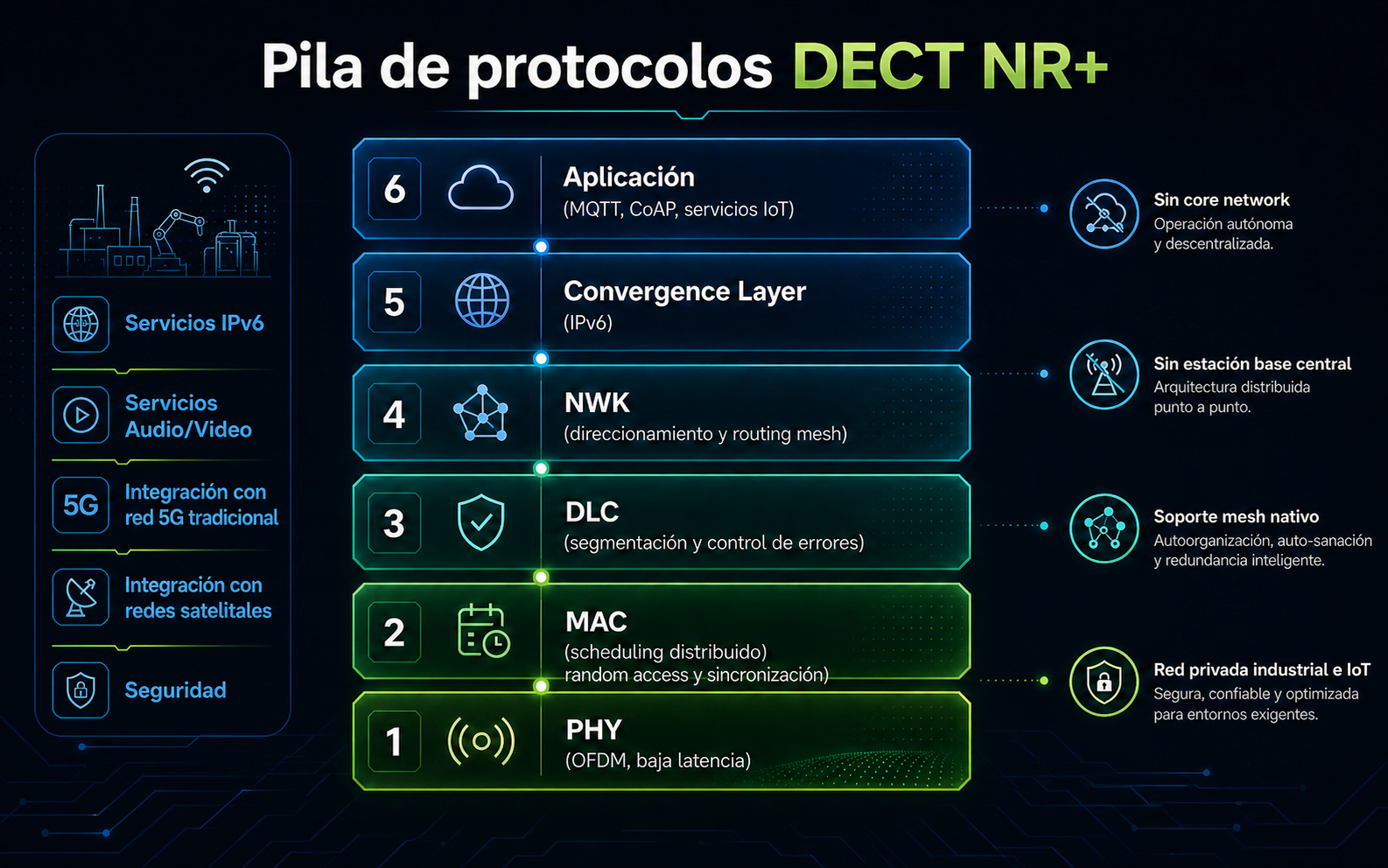
Qartia can take this approach to a concrete architecture, with coverage study, network definition, integration with devices and commissioning in the field.